I’ve seen too many security professionals get blindsided by threats their training never prepared them for.
You’re probably here because you know something’s off. The security courses you’ve taken feel outdated the moment you finish them. Checklist approaches don’t work when threats evolve daily.
Here’s the reality: traditional security training teaches you to respond to yesterday’s attacks. But modern threats are driven by AI and they adapt faster than your quarterly training updates.
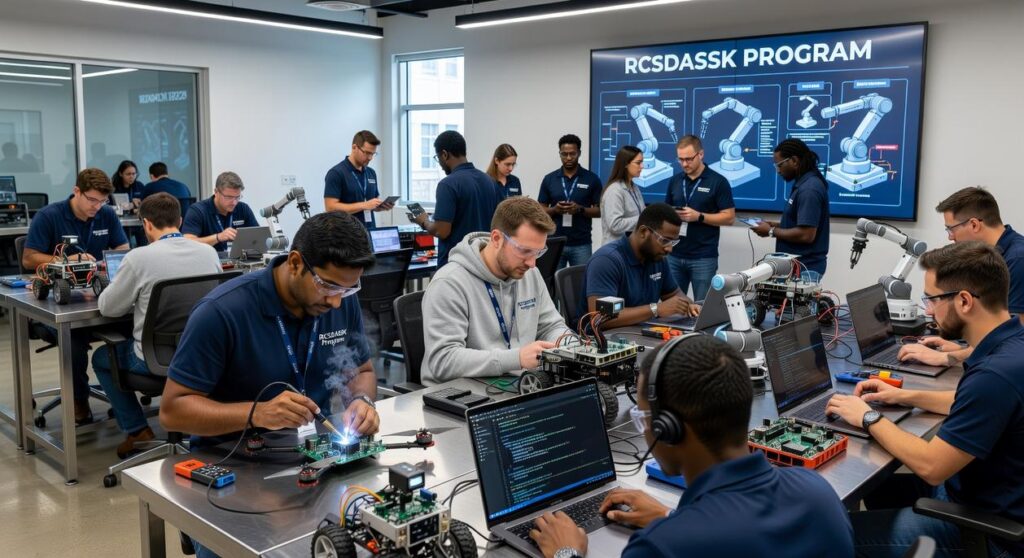
The rcsdassk program takes a different approach. It’s not another certification course. It’s a cognitive framework that teaches you to think like the threats you’re defending against.
I built this program after watching security teams struggle with the same problem over and over. They knew the rules but couldn’t adapt when attackers changed the game.
This article breaks down how rcsdassk program works. You’ll see each core module and understand how it shifts your mindset from reactive to predictive.
We focus on emerging threats that most training programs ignore. Machine learning attacks. Quantum computing vulnerabilities. The stuff that’s coming whether you’re ready or not.
You’ll learn why static training fails and what you need to build real digital resilience.
Deconstructing the RCSDASSK Framework: A New Paradigm for Security
Have you ever wondered why security breaches keep happening to companies with massive budgets and entire teams dedicated to defense?
It’s not because they lack resources.
The problem is simpler. Most security frameworks are built on outdated assumptions. They treat threats like static problems you can solve once and forget about.
But that’s not how attacks work anymore.
I built rcsdassk because I kept seeing the same pattern. Organizations would implement security protocols that looked great on paper but fell apart the moment real threats emerged.
Some experts will tell you that traditional security models are fine if you just follow them correctly. They say the issue is execution, not the framework itself.
Here’s where I disagree.
The frameworks themselves are the problem. They can’t adapt fast enough because they weren’t designed for the world we live in now.
What RCSDASSK Actually Means
RCSDASSK stands for Risk-Adaptive Cognitive and Secure Development Situational Strategy Kit.
I know. It’s a mouthful.
But each piece matters. Let me break down why the Rcsdassk program works differently than what you’re used to.
Risk-Adaptive Core means you stop relying on fixed rules. Instead, you learn to assess risk continuously and adjust your controls in real time. Think of it like this: most security is a locked door. This is a door that changes its lock every time someone tries to pick it.
Cognitive and AI-Driven Defense is where things get interesting. You’re using machine learning to predict threats before they happen and automate responses when they do. Not just reacting. Actually seeing what’s coming.
Secure Development and Situational Strategy brings it all together. Security isn’t something you bolt on at the end. It’s woven into every stage of development, and you train against real scenarios that actually happen in the field.
Sound familiar? That disconnect between theory and practice?
That’s what this fixes.
Module 1: Proactive Defense & System Hardening
Most security training still teaches you to patch vulnerabilities after they’re discovered.
That’s already too late.
I built this module around a different approach. You learn to design systems that resist attacks from the ground up.
Beyond Patching
Traditional patching is reactive. You wait for someone to find a hole, then scramble to fix it.
Immutable infrastructure flips this model. When your servers can’t be modified after deployment, attackers have nowhere to plant their tools. If something goes wrong, you replace the entire instance instead of trying to clean it.
Zero-trust architecture works the same way. You stop assuming anything inside your network is safe. Every request gets verified, every time (even from systems that were trusted five minutes ago).
According to Gartner’s 2023 security report, organizations using zero-trust principles saw 45% fewer successful breaches than those relying on perimeter defenses alone.
Advanced Threat Modeling
Legacy threat modeling was built for monolithic applications sitting in data centers.
That doesn’t work anymore.
Microservices spread your attack surface across dozens of containers. Cloud-native apps introduce new risks that didn’t exist five years ago. You need modeling techniques that account for API gateways, service meshes, and ephemeral workloads.
The rcsdassk program teaches you frameworks like STRIDE and PASTA, then shows you how to adapt them for modern architectures. You’ll map threats specific to Kubernetes clusters and serverless functions.
Automated Security Validation
Here’s what I see constantly. Teams build security checks but run them manually before release.
Which means they get skipped when deadlines hit.
The labs in this module put security tools directly into your CI/CD pipeline. Static analysis runs on every commit. Container scanning happens before images reach production. Configuration checks block deployments that violate your policies.
You’ll work with tools like Snyk, Trivy, and OWASP Dependency-Check. By the end, your pipeline catches vulnerabilities before they ship (without slowing down your release cycle).
Some people argue automation creates false positives that waste time. They prefer manual reviews.
But manual reviews don’t scale. And they definitely don’t happen at 2 AM when someone pushes an error rcsdassk fix to production.
Module 2: Machine Learning for Predictive Threat Intelligence

Most security teams are fighting yesterday’s battles.
They rely on signature-based detection. They wait for threats to appear before they react. And by then, the damage is already done.
Here’s what I’ve learned after years in this field.
Traditional tools miss about 70% of advanced threats (according to a 2023 Ponemon Institute study). That’s not a small gap. That’s a massive blind spot that attackers exploit every single day.
Some people argue that ML-based detection creates too many false positives. They say it’s not worth the noise. And sure, poorly configured systems do generate alerts that waste time.
But ignoring ML entirely? That’s how you miss the Rcsdassk Problem of subtle, persistent threats that traditional signatures will never catch.
Building Anomaly Detection Engines
I’ll show you how to build detection systems that actually work.
The rcsdassk program teaches you to use supervised and unsupervised learning algorithms to spot patterns that humans can’t see. We’re talking about behavioral anomalies in network traffic, user access patterns that deviate by fractions of a percent, and lateral movement that happens over weeks instead of hours.
Real example: One student identified a credential theft campaign by detecting login attempts that were statistically normal but happened 0.3 seconds faster than the user’s typical pattern. Signature tools saw nothing wrong.
Predictive Analytics for Threat Hunting
You can’t hunt what you can’t predict.
I teach you to use historical breach data to build predictive models. You’ll learn to analyze attack timelines, correlate threat actor TTPs (tactics, techniques, and procedures), and forecast where the next probe will likely occur.
Research from MIT’s CSAIL lab shows that predictive models can identify attack vectors up to 85% of the time before they’re actively exploited.
Automating Incident Response with SOAR
Speed matters more than most people think.
IBM’s 2024 Cost of a Data Breach report found that organizations with automated response capabilities saved an average of $1.8 million per breach compared to those using manual processes.
You’ll get hands-on training with SOAR platforms to cut your MTTD and MTTR in half. We build playbooks that trigger automatically when specific conditions are met, freeing your team to focus on complex investigations instead of repetitive tasks.
Module 3: Future-Proofing Skills for the Next Decade
You know what keeps most security professionals up at night? I expand on this with real examples in Rcsdassk Release.
It’s not the threats they can see. It’s the ones coming around the corner.
I’m talking about quantum computing. And if you think that’s some far-off science fiction problem, you’re already behind.
Here’s what most people don’t get. The encryption protecting your data right now? RSA, ECC, all the standards we rely on? They’re about to become obsolete.
Some experts say we shouldn’t worry yet. They claim quantum computers powerful enough to break current encryption are still years away. Maybe they’re right about the timeline.
But here’s what they’re missing.
Harvest now, decrypt later attacks are happening TODAY. Adversaries are collecting encrypted data right now, waiting for quantum computers to crack it open. Your “secure” communications from 2025 could be readable in 2030.
That’s where Module 3 of the rcsdassk program comes in.
What You Actually Get
This module teaches you three things that’ll keep you relevant when everyone else is scrambling.
First, you’ll learn DevSecOps the right way. Not just the tools, but how to actually get developers and security teams working together instead of fighting each other. (Trust me, the cultural shift is harder than the technical one.)
You’ll walk away knowing how to build security into every stage of development. No more bolting it on at the end and hoping for the best.
Second, we break down the quantum threat in plain terms. You’ll understand exactly how quantum computers will crack RSA and ECC. More importantly, you’ll know WHEN to start worrying and what to do about it.
Third, you get hands-on with Post-Quantum Cryptography.
| Old Standard | Quantum Vulnerable? | PQC Alternative |
|---|---|---|
| RSA | YES | Lattice-based algorithms |
| ECC | YES | Hash-based signatures |
| AES-256 | Partially | Increased key sizes |
We cover lattice-based cryptography, hash-based signatures, and the other algorithms that’ll replace what we use now. You’re not just learning theory. You’re getting practical experience with the tools that’ll define the next decade.
Here’s the benefit nobody talks about.
While your colleagues are still figuring out what quantum computing even means, you’ll already know how to migrate systems to post-quantum standards. That makes you IRREPLACEABLE.
The transition to PQC isn’t optional. It’s coming whether we’re ready or not. The only question is whether you’ll lead it or get left behind.
From Trainee to Strategist: The RCSDASSK Advantage
You didn’t get into security to play catch-up forever.
But that’s exactly what happens when you rely on outdated knowledge. Threats evolve faster than most training programs can keep up with. You end up reacting instead of planning.
The rcsdassk program changes that equation.
It gives you the cognitive tools to think like a strategist instead of a firefighter. You’ll learn to anticipate threats before they materialize and build defenses that actually hold up against modern attacks.
I designed this framework around future-focused knowledge. Machine learning patterns. Quantum computing risks. Real-world app vulnerabilities that most courses ignore.
You came here because reactive security isn’t cutting it anymore. Now you know there’s a better approach.
Stop Reacting and Start Leading
Outdated security knowledge puts your career and your organization at risk. The rcsdassk program fixes that by teaching you to think proactively about defense.
Download the full syllabus to see exactly what you’ll learn. Preview a module to experience the difference yourself. Or explore enrollment options if you’re ready to make the shift.
The security landscape won’t wait for you to catch up. Your next move determines whether you’re leading the defense or scrambling to patch holes.