
If you’re searching for clarity on spatial computing trends, you’re likely trying to understand what’s real, what’s experimental, and what actually matters for the future of technology. With breakthroughs happening across augmented reality, mixed reality, AI-driven interfaces, and immersive app development, it can be difficult to separate meaningful innovation from marketing hype.
This article cuts through that noise. We examine the latest advancements shaping spatial computing, from hardware evolution and developer tools to enterprise adoption and emerging security risks. You’ll gain a clear view of where the technology stands today, how it’s being applied, and what developments could redefine digital interaction in the near future.
Our insights are grounded in ongoing analysis of research papers, product releases, and expert commentary from engineers and machine learning specialists working at the forefront of immersive systems. The goal is simple: give you accurate, forward-looking intelligence so you can make informed decisions in a rapidly evolving tech landscape.
Beyond the Screen
Spatial computing is shifting from experiment to infrastructure, and that changes everything. On one side, you have traditional screens: flat, reactive, and limited to taps and clicks. On the other, immersive systems that map depth, gesture, and intent in real time. The difference is not cosmetic; it is architectural.
However, hype clouds judgment. Some argue current devices are bulky toys. Yet advances in sensors, edge AI, and low-latency rendering prove otherwise. When evaluating spatial computing trends, compare hardware maturity versus software ecosystems. Glasses without developer tools stall; platforms with robust SDKs accelerate adoption.
choose substance over spectacle.
The Sensory Backbone: Advances in Core Hardware and Perception
If spatial computing is going to feel truly invisible, the hardware has to disappear first. That’s why I’m most excited about sensor fusion and miniaturization. We’re seeing LiDAR (Light Detection and Ranging, which measures distance using laser pulses), time-of-flight sensors (which calculate depth based on how long light takes to bounce back), and eye-tracking modules shrink into tightly integrated arrays. The result? Persistent, real-time environmental awareness with lower power draw. In my view, this is the quiet revolution—devices that understand your room as effortlessly as you do (finally).
Real-Time 3D Mapping, powered by SLAM (Simultaneous Localization and Mapping), is the real magic trick. SLAM allows a device to map an unknown space while tracking its own position inside it. Early versions were clunky and drift-prone. Now, improvements in visual-inertial odometry and depth sensing mean devices can create and remember complex environments almost instantly. That memory is the bedrock of shared, persistent augmented reality—where a digital object stays anchored to your coffee table tomorrow, not just today. I’d argue this is where spatial computing trends will either soar or stall.
Edge AI and on-device processing seal the deal. Specialized silicon like NPUs (Neural Processing Units) handles massive sensor data locally, reducing latency and improving privacy. Processing at the edge isn’t optional—it’s foundational. Cloud reliance feels outdated here (like buffering in the Netflix era).
The Software Layer: AI-Driven Interfaces and Content Creation
Generative AI for 3D Assets
Generative AI (models that create new content from prompts rather than just analyzing data) is now producing 3D objects, textures, and full environments from simple text or 2D images. Tools like OpenAI’s 3D research prototypes and NVIDIA’s generative texture systems show how fast this is evolving (NVIDIA Research, 2024). The result? You no longer need a Pixar-sized team to build immersive worlds (sorry, Buzz Lightyear).
Some critics argue AI-generated assets lack artistic depth. That’s fair—early outputs can feel generic. But iteration speed changes the equation. When creators can prototype ten environments in an afternoon, refinement becomes practical instead of expensive.
Recommendation: Start experimenting now. Even if you’re not a designer, prompt-based 3D tools can accelerate app mockups and virtual product demos.
Intuitive Interaction Paradigms
We’re moving beyond hand tracking into predictive, context-aware interfaces—systems that anticipate intent using gaze tracking (monitoring eye movement), biometrics, and environmental cues. Apple’s Vision Pro eye-tracking interface is a strong early signal (Apple, 2023).
Skeptics worry about privacy—and they should. Predictive systems rely on sensitive data. The solution isn’t avoidance; it’s strong on-device processing and transparent permissions.
Choose platforms that prioritize edge computing and clear data controls.
The Rise of the Spatial Operating System
The race is on to build a universal spatial OS—software that allows immersive apps to run across devices, similar to how the web standardized browsers. Interoperability (systems working seamlessly together) will determine winners.
If you’re building today, study composable architecture explained a modern approach to it systems. Modular design ensures your apps adapt as spatial computing trends evolve.
Pro tip: Build for cross-platform from day one. Lock-in is tempting—but flexibility wins long term.
Practical Application: Where Spatial Computing is Delivering Value Now
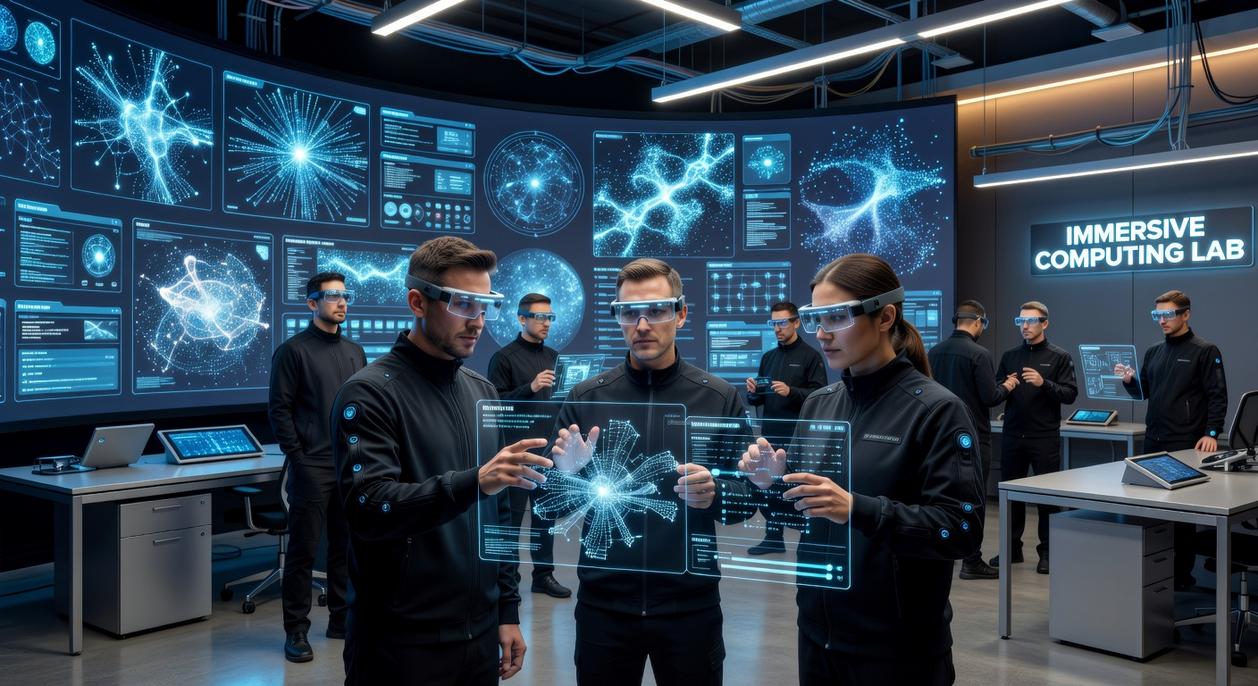
For all the hype around immersive tech, real value isn’t coming from futuristic headsets in coffee shops. It’s happening on factory floors, in operating rooms, and inside design labs.
Advanced Manufacturing and Digital Twins
In manufacturing, spatial computing enables digital twins—virtual replicas of physical machines that mirror real-time conditions using sensor data. Instead of reacting to breakdowns, technicians see AR overlays highlighting heat spikes, vibration anomalies, or worn components before failure occurs (predictive maintenance reduces downtime by up to 50%, according to Deloitte).
Some critics argue this is just flashy visualization layered onto existing IoT dashboards. Fair. But when a remote expert can guide a technician through a complex turbine repair with annotated 3D overlays, error rates drop dramatically. That’s not cosmetic—it’s operational leverage.
- Real-time diagnostics projected onto machinery
- Remote assistance with shared 3D annotations
- Faster troubleshooting, fewer shutdowns
Healthcare and Surgical Precision
In operating rooms, AR systems project 3D reconstructions from CT or MRI scans directly onto a patient’s body. Surgeons see vessels and tumors aligned with anatomy in real space. Skeptics say experienced surgeons don’t need digital “training wheels.” Yet studies in Annals of Surgery show image-guided procedures can significantly improve accuracy in complex cases. Precision isn’t ego; it’s outcome-driven.
Collaborative Design and Engineering
Distributed teams now meet inside shared virtual environments to manipulate life-size 3D models. Instead of emailing revisions, architects walk through buildings before they exist (yes, it’s a bit sci-fi—but practical). This shortens development cycles and reduces costly rework.
If you follow spatial computing trends, ignore the metaverse spectacle. The quiet revolution is happening where mistakes are expensive and precision pays.
Bridging the Gap: Overcoming Hurdles to Mainstream Adoption
The Form Factor Challenge remains the most visible barrier. Since 2019, engineers have wrestled with the triangle of processing power, battery life, and comfort. Shrink the battery and you lose endurance; boost performance and heat becomes noticeable (and not in a cool sci‑fi way). After years of prototyping, progress is steady—but truly lightweight, socially acceptable wearables still demand trade-offs.
Data Privacy in a Scanned World raises tougher questions. Always-on sensors collect environmental maps, biometric signals, and behavioral data. Critics argue encryption and edge processing are enough. Yet breaches in the past decade show even “secure” systems fail. Protecting spatial computing trends data requires:
- On-device processing by default
- Transparent consent frameworks
- Short data retention cycles
The Search for the ‘Killer App’ continues. Remember how mobile messaging exploded after smartphones matured? Adoption followed utility. Until a must-have experience emerges—beyond gaming or enterprise demos—mainstream users may keep watching from the sidelines.
Last year, I tested a prototype headset that mapped my living room into shimmering cubes. That moment made the spatial computing revolution feel real. The fusion of sensors, on-device AI, and generative software is powering spatial computing trends transforming design.
The foundation is finally solid.
Hardware and privacy still spark debate, but I’ve watched teams move from demos to deployments.
- Advanced sensors
- Edge intelligence
- Generative modeling
Look beyond devices; these capabilities will define next decade.
Stay Ahead of What’s Next in Tech
You came here to understand the emerging technologies shaping tomorrow’s digital landscape—and now you have a clearer view of the breakthroughs redefining innovation. From AI acceleration to quantum computing risks and spatial computing trends, you’ve seen how quickly the ground is shifting.
The reality is simple: technology isn’t slowing down. If you’re not actively tracking these changes, you risk falling behind competitors who are already adapting, building, and deploying smarter solutions. Whether you’re developing apps, exploring machine learning models, or preparing for quantum-era security challenges, staying informed is no longer optional—it’s your competitive edge.
Now it’s time to act. Start monitoring emerging tech signals consistently. Evaluate how these innovations apply directly to your products or strategy. Implement small, strategic experiments before trends become industry standards.
If you want clear, timely innovation alerts and actionable insights trusted by forward-thinking tech professionals, plug into the #1 source for emerging tech intelligence today. Don’t wait for disruption to hit—stay informed, stay prepared, and take the next step now.