

If you’re trying to understand the difference between supervised vs unsupervised learning, you’re likely looking for clear, practical guidance—not textbook jargon. Whether you’re building a machine learning model, evaluating AI tools, or simply expanding your technical knowledge, knowing how these two approaches work (and when to use each) is essential.
This article breaks down the core distinctions, real-world applications, advantages, and limitations of both methods. You’ll see how labeled data shapes supervised models, how pattern discovery drives unsupervised systems, and why choosing the wrong approach can impact performance, accuracy, and scalability.
Our insights are grounded in current machine learning research, industry case studies, and analysis of real-world deployment scenarios across emerging technologies. By the end, you’ll have a practical, decision-focused understanding of how to evaluate and apply each learning method with confidence.
Machine learning breakthroughs aren’t driven solely by smarter algorithms; they’re powered by the data you feed them. In practice, many teams stumble because they confuse supervised vs unsupervised learning. Simply put, labeled data comes with answers—like spam emails tagged “junk”—while unlabeled data requires models to find hidden patterns, such as customer segments. Therefore, if you’re predicting outcomes, choose supervised methods. However, if you’re exploring unknown structures, start with clustering or dimensionality reduction. As a rule, clarify your business question first, then match the data type to the technique. Do this, and you’ll build smarter, more reliable AI systems.
Supervised Learning: Training AI with a Known Answer Key
Supervised learning is a machine learning approach where a model is trained on labeled data—data that already includes the correct answers. Think of it as learning with an answer key in hand. The system’s task is simple: study examples, detect patterns, and predict correct outcomes for new data.
Imagine a student using flashcards. Each card shows a question (input data) on one side and the answer (label) on the other. Over time, the student associates patterns with correct responses. Supervised learning works the same way: labeled data → model training → prediction → feedback loop. The model makes a prediction, compares it to the known answer, adjusts, and improves. (Yes, it’s basically practice tests for robots.)
This differs from supervised vs unsupervised learning because unsupervised learning provides no answer key—just raw data to interpret.
Core Use Cases
- Image Classification: A model trained on thousands of labeled cat photos can identify cats in new images. This powers features like photo tagging in smartphones.
- Spam Detection: Email systems learn from historical “spam” and “not spam” labels to filter inboxes effectively (saving you from dubious prince offers).
- Predictive Analytics: Retailers forecast future sales using past sales data, improving inventory planning and revenue stability.
Common Algorithms
- Classification (Logistic Regression): Predicts categories, such as yes/no or spam/not spam.
- Regression (Linear Regression): Predicts numerical values, like sales totals.
Recommendation: Start with clean, well-labeled data before experimenting with complex models. Pro tip: Better data quality often beats fancier algorithms (Google’s research consistently highlights data quality as a key performance driver).
Unsupervised Learning: Discovering Hidden Patterns on Its Own
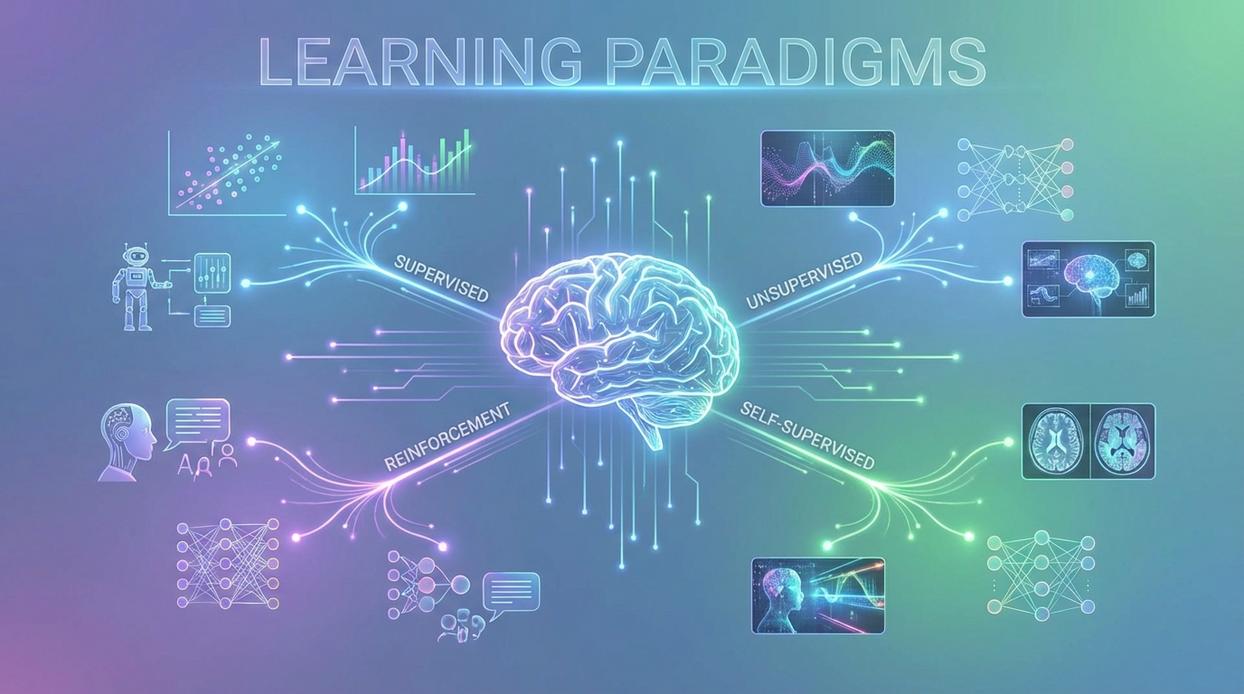
Unsupervised learning is a type of machine learning where algorithms explore data without pre-existing labels. In simple terms, there’s no answer key. The system examines raw information and identifies hidden structures, trends, or groupings on its own. If supervised vs unsupervised learning is the debate, think of it this way: one learns with flashcards, the other learns by sorting a messy box of photos with no captions.
How It Works
Imagine a detective walking into a room full of scattered evidence—receipts, fingerprints, phone logs—but no description of the crime. The detective searches for patterns first, then figures out what they might mean.
The process typically follows three steps:
- Unlabeled data – Raw datasets with no predefined categories.
- Algorithm analysis – Mathematical models scan for similarities or correlations.
- Pattern discovery – The system forms clusters or associations based on shared traits.
Pro tip: Clean, well-structured data dramatically improves results. For deeper insight, explore how feature engineering impacts machine learning model accuracy.
Core Use Cases (Actionable Examples)
- Customer Segmentation: Upload purchase histories into a clustering tool like K-Means to group buyers by behavior. Marketers can then tailor campaigns to each persona.
- Anomaly Detection: Train a model on typical credit card transactions; flag outliers that deviate significantly (often used in fraud detection systems).
- Recommendation Engines: Platforms like Netflix cluster viewers with similar tastes to suggest new content (yes, that’s why your homepage feels oddly accurate).
Common Algorithms
- Clustering (K-Means): Groups similar data points into “clusters” based on distance or similarity.
- Association (Apriori): Finds relationships between items, such as customers who buy bread often buying butter too.
When applied thoughtfully, unsupervised learning turns raw data into meaningful insight.
Head-to-Head Comparison: A Practical Breakdown
When evaluating supervised vs unsupervised learning, clarity matters. After all, choosing the right approach can save you time, resources, and costly experimentation. Here’s a practical comparison to help you decide:
-
Input Data:
-
Supervised: Labeled and structured data (e.g., tagged emails marked “spam” or “not spam”).
-
Unsupervised: Unlabeled and often unstructured data (e.g., raw customer browsing behavior).
-
Primary Goal:
-
Supervised: Prediction and classification—forecasting sales or detecting fraud.
-
Unsupervised: Exploration and pattern discovery—identifying hidden customer segments.
-
Complexity:
-
Supervised: Typically less complex to configure but demands extensive data preparation and labeling.
-
Unsupervised: Computationally more complex, yet requires far less manual labeling effort.
-
Approach:
-
Supervised: Task-driven—we know the desired output.
-
Unsupervised: Data-driven—we let patterns emerge naturally.
-
Feedback Mechanism:
-
Supervised: Direct feedback from labeled “ground truth” data.
-
Unsupervised: No inherent feedback loop for validation.
So what’s in it for you? With this breakdown, you can align your project goals with the right method, reduce wasted development cycles, and accelerate meaningful insights. Why guess when you can choose strategically?
Choosing the right technique can SAVE time and money. Start with four questions:
- Do you have access to a reliable, labeled dataset? If yes, supervised vs unsupervised learning becomes a fork in the road.
- Is your goal to predict a known outcome? That points toward models optimized for accuracy and measurable ROI.
- Or do you want to understand the structure of your data? Think clustering that reveals segments (like discovering Spotify-style listener tribes).
- Are you trying to find unusual or novel patterns? Anomaly detection can flag fraud or system threats fast.
Answering these clarifies scope, reduces risk, and drives impact.
Beyond the Binary
I once built a prototype that failed because I treated supervised vs unsupervised learning like a boxing match. My dataset was messy, labels scarce, and my ego LOUD. A mentor told me to start with the problem, not the paradigm. That advice changed everything. The truth is, choosing an approach is about fit, not superiority. Hybrid systems, especially semi-supervised learning, blend structure with discovery. They use small labeled sets to guide patterns found in vast unlabeled pools. Think of it as giving AI a compass, not a cage. Let evidence, not ego, drive decisions from the start.
As we explore the key differences between supervised and unsupervised learning, it’s essential to consider how these approaches can enhance applications in emerging technologies, such as the growing field of spatial computing that extends beyond traditional AR and VR – for more details, check out our The Rise of Spatial Computing: Beyond AR and VR.
Move Forward with Smarter Machine Learning Decisions
You set out to better understand how machine learning works and where it fits into today’s rapidly evolving tech landscape. Now you have clarity on core concepts, practical applications, and the real-world impact of supervised vs unsupervised learning across industries.
The real challenge isn’t access to information — it’s keeping up. Emerging tools, shifting algorithms, and growing quantum computing threats make it easy to fall behind. And in tech, falling behind means missed opportunities, slower innovation, and competitive disadvantage.
The advantage belongs to those who stay informed and act early.
If you’re serious about leveraging machine learning, strengthening your app development strategy, or preparing for next-gen computing risks, don’t stop here. Get real-time tech innovation alerts, track emerging trends, and apply practical insights before your competitors do.
Join thousands of forward-thinking professionals who rely on trusted, data-driven updates to stay ahead. Subscribe now and turn insight into action.
 Ask James Danielsaylamans how they got into app development techniques and you'll probably get a longer answer than you expected. The short version: James started doing it, got genuinely hooked, and at some point realized they had accumulated enough hard-won knowledge that it would be a waste not to share it. So they started writing.
What makes James worth reading is that they skips the obvious stuff. Nobody needs another surface-level take on App Development Techniques, Emerging Tech Concepts and Trends, Machine Learning Insights. What readers actually want is the nuance — the part that only becomes clear after you've made a few mistakes and figured out why. That's the territory James operates in. The writing is direct, occasionally blunt, and always built around what's actually true rather than what sounds good in an article. They has little patience for filler, which means they's pieces tend to be denser with real information than the average post on the same subject.
James doesn't write to impress anyone. They writes because they has things to say that they genuinely thinks people should hear. That motivation — basic as it sounds — produces something noticeably different from content written for clicks or word count. Readers pick up on it. The comments on James's work tend to reflect that.
Ask James Danielsaylamans how they got into app development techniques and you'll probably get a longer answer than you expected. The short version: James started doing it, got genuinely hooked, and at some point realized they had accumulated enough hard-won knowledge that it would be a waste not to share it. So they started writing.
What makes James worth reading is that they skips the obvious stuff. Nobody needs another surface-level take on App Development Techniques, Emerging Tech Concepts and Trends, Machine Learning Insights. What readers actually want is the nuance — the part that only becomes clear after you've made a few mistakes and figured out why. That's the territory James operates in. The writing is direct, occasionally blunt, and always built around what's actually true rather than what sounds good in an article. They has little patience for filler, which means they's pieces tend to be denser with real information than the average post on the same subject.
James doesn't write to impress anyone. They writes because they has things to say that they genuinely thinks people should hear. That motivation — basic as it sounds — produces something noticeably different from content written for clicks or word count. Readers pick up on it. The comments on James's work tend to reflect that.